




19+ Types of Panties for Women: A Complete Underwear Guide
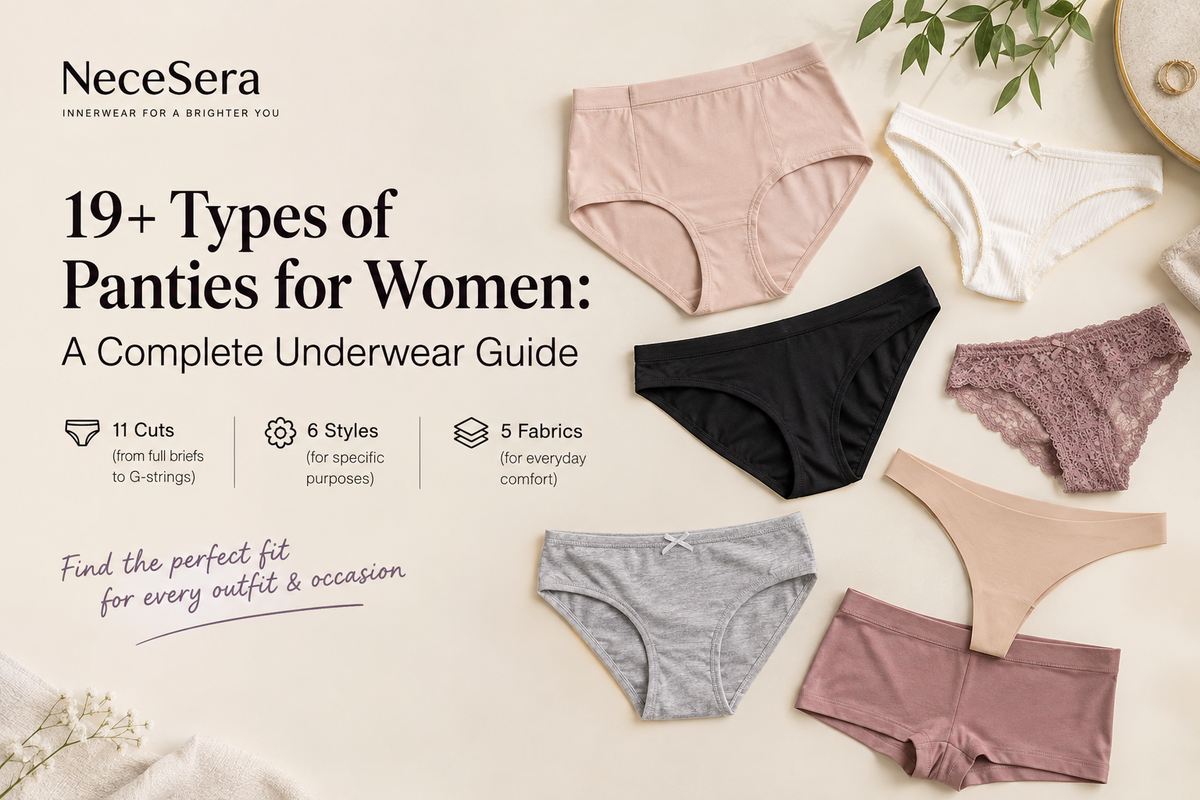
There are more than 19 types of panties for women, and this guide covers 22 of them in three groups: 11 cuts (from full briefs to G-strings), 6 styles made for a specific purpose (such as seamless, period and maternity panties) and 5 everyday fabrics. For most days, briefs, hipsters, bikinis and boyshorts are the most comfortable choices, while thongs and seamless panties are made for fitted clothes.
Knowing the different types of underwear for women helps you pick a pair that stays comfortable all day and disappears under your outfit. Below, each type is explained in plain terms: how much it covers, where it sits on your waist and when to wear it. If you already know the cut you like, you can compare panties for women by style and fabric.

All Panty Types by Name: Quick Reference
Not sure what a style is called? These are the panty names and underwear names for ladies you will see most often, with the coverage each one gives.
|
# |
Panty type |
Group |
Coverage |
Best for |
|
1 |
Brief (full brief) |
Cut |
Full front and back |
All-day everyday wear |
|
2 |
High-waist brief |
Cut |
Full, above the navel |
High-waisted jeans, sarees, light tummy smoothing |
|
3 |
Hipster |
Cut |
Full back, low on the hips |
Low-rise jeans, kurtas, period days |
|
4 |
Bikini |
Cut |
Moderate, hip level |
Everyday wear under most outfits |
|
5 |
Boyshorts (and shorties) |
Cut |
Full, extends to the upper thigh |
Skirts, dresses, lounging |
|
6 |
French cut |
Cut |
Moderate, high leg |
Lengthening the leg |
|
7 |
Brazilian |
Cut |
Less than a bikini, more than a thong |
Fitted clothes without a full thong |
|
8 |
Cheeky |
Cut |
Partial back |
Fitted skirts and trousers |
|
9 |
Tanga |
Cut |
Partial back, narrow sides |
Low-rise outfits |
|
10 |
Thong |
Cut |
Minimal back |
Bodycon dresses, leggings |
|
11 |
G-string |
Cut |
Least coverage |
Sheer or very tight clothes |
|
12 |
Seamless panty |
Purpose |
Varies by cut |
No visible lines under fitted clothes |
|
13 |
Period panty |
Purpose |
Usually full |
Light flow or backup on heavy days |
|
14 |
Maternity panty |
Purpose |
Full, over or under the bump |
Pregnancy and postpartum |
|
15 |
Shapewear (control brief) |
Purpose |
Full, firm panels |
Smoothing under occasion wear |
|
16 |
Sports panty |
Purpose |
Moderate to full |
Workouts and active days |
|
17 |
Adaptive panty |
Purpose |
Varies |
Mobility or sensory needs |
|
18 |
Cotton panty |
Fabric |
Any cut |
Daily wear, sensitive skin, hot weather |
|
19 |
Modal panty |
Fabric |
Any cut |
Softness and drape |
|
20 |
Microfibre panty |
Fabric |
Any cut |
Smooth finish under tight clothes |
|
21 |
Lace panty |
Fabric |
Any cut |
Occasions and special outfits |
|
22 |
Silk or satin panty |
Fabric |
Any cut |
Bridal and special occasions |
Related Reading: Panties vs Underwear: What's The Difference?
What Are Panties?
What are panties? Panties are close-fitting underwear worn by women and girls on the lower body. They keep the intimate area clean and comfortable, give a smooth base under clothes and hold sanitary pads or liners in place.
The word started as "pants" with a diminutive ending. It was first used in 1845 for men's drawers, and its meaning as "underpants for women or girls" is recorded by 1908. "Panty" is simply the singular, so there is no panty full form. Underwear that looks like modern panties first appeared in the 1920s, when long drawers were shortened.
So what is women's underwear called around the world? In the UK and Ireland it is called knickers, and "undies" and "underwear" are gender-neutral terms. In India, women's underwear is often called innerwear, inners or undergarments for women. The lingerie meaning is wider: the word comes from the French "linge" (linen) and covers bras, sleepwear and robes as well as panties.
What Are the Different Types of Panties for Women
Knowing the different types of panties for women helps you pick the right lingerie for your style, comfort, and daily needs. Each type caters to different preferences, occasions, and body types. NeceSera’s innerwear collection offers many of these styles in Supima cotton and modal blends that stay soft wash after wash.
Types of Panties Based on Cut and Coverage
The cut decides how much a panty covers, where the waistband sits and how it looks under clothes. These panty cuts (sometimes searched as panty shapes) are listed from most to least coverage.
1. Brief (Full Brief)
Briefs give full coverage at the front and back, with a waistband at or just below the navel. They are sometimes called full briefs or "granny panties", and they stay in place through long days. A soft cotton-modal pair, like these everyday briefs, is the easiest place to start.
• Rise: mid to high
• Best for: all-day everyday wear and anyone who wants maximum coverage
2. High-Waist Brief
High-waist briefs sit above the navel and cover the lower tummy. The extra height stops the waistband from rolling down under high-waisted jeans, skirts and sarees, and gives a light smoothing effect.
• Rise: high
• Best for: high-waisted bottoms and ethnic wear

3. Hipster
Hipsters sit low on the hips with wide side panels and full back coverage. They sit between a bikini and a boyshort, which is why so many body types find hipster panties comfortable, and why they are popular on period days.
• Rise: low
• Best for: low-rise jeans, kurtas and everyday comfort
4. Bikini
Bikini panties sit at hip level with a higher leg opening than briefs and moderate back coverage. Bikini panties are one of the most popular everyday styles because they work under most outfits.
• Rise: low to mid
• Best for: everyday wear and low-rise clothes
Related Reading: Bikini vs. Brief Panties: A Simple Guide to Choosing the Right Fit
5. Boyshorts and Shorties
Boyshorts look like small shorts and extend to the top of the thigh, covering the hips and buttocks fully. Shorties are a snugger, more form-fitting version that stays put when you move. Both help prevent thigh chafing, which is why many women wear boyshort panties under skirts and dresses.
• Rise: low to mid
• Best for: skirts, dresses, lounging and active days

Related Reading: Boyshorts vs Hipsters vs Briefs: Which Panty Style Is Right for You?
6. French Cut Panties
French cut panties, also called high-cut briefs, have leg openings that sit above the hip bone. The high leg makes legs look longer while keeping brief-style coverage at the back.
• Rise: mid to high
• Best for: a leg-lengthening line and high-cut outfits

7. Brazilian Panties
A Brazilian panty sits on or below the waistline and has less back coverage than a bikini but more than a thong. It suits anyone who wants fewer lines under fitted clothes without wearing a thong.
• Rise: low
• Best for: fitted trousers and skirts
8. Cheeky Panties
Cheeky panties show part of the buttocks, with a back that sits partly between the cheeks. They give moderate coverage at the front and look neat under fitted clothes.
• Rise: low to mid
• Best for: fitted skirts and trousers

9. Tanga Panties
A tanga panty is a hybrid of a bikini and a thong: narrow at the sides with partial back coverage. It reduces visible lines without the minimal back of a full thong.
• Rise: low
• Best for: low-rise outfits

10. Thong
A thong has a narrow strip of fabric at the back that joins the waistband to the gusset. It removes visible panty lines under bodycon dresses, leggings and fitted trousers.
There are four common types of thongs:
• T-back: a T-shaped back, slightly wider than a G-string.
• Brazilian thong: a little more back fabric than a classic thong.
• Lace thong: any thong cut made in lace.
• Seamless thong: bonded or laser-cut edges with no stitching to show through.

Related Reading: Different Types of Thongs
11. G-String
A G-string has a small triangle at the front and a thin string at the back, so it gives the least coverage of any panty. It is usually saved for sheer or very tight outfits rather than everyday wear.
• Rise: low
• Best for: sheer and very fitted clothes
5- G-Strings
G-strings are similar to thongs but offer even less coverage. They feature a small triangle of fabric at the front and a thin string at the back for support. G-strings are popular for their ability to eliminate panty lines completely, making them an excellent choice for tight-fitting outfits or special occasions. While not typically worn for everyday use, G-strings can be the perfect underwear choice for very form-fitting or sheer clothing.
Best For: Special occasions or outfits where no panty line is key.

Types of Panties Based on Purpose
Some types of women's underwear are designed around a specific need rather than a cut. Most of them come in several cuts.
12. Seamless Panties
Seamless panties have bonded or laser-cut edges instead of stitched elastic, so nothing shows through tight fabric. They come as briefs, bikinis, hipsters and thongs.
• Best for: leggings, bodycon dresses, fitted kurtas and sarees

Related Reading: Seamless vs Regular Underwear: Which Is Better for Your Skin?
13. Period Panties
Period panties, also called menstrual panties, have an absorbent, multi-layer gusset that holds fluid and controls odour. They can replace pads on light days or act as backup on heavy days, and usually come in brief, hipster and boyshort cuts.
• Best for: light flow days and backup protection
14. Maternity Panties
Maternity panties have a soft, stretchy waistband that sits under the bump or stretches over it without digging in. Over-bump styles give more support later in pregnancy, and under-bump styles suit early months and postpartum.
• Best for: pregnancy and the months after birth

15. Shapewear (Control Briefs Panties)
Shapewear panties, also called control briefs or tummy tuckers, use firm stretch panels to smooth the tummy, waist and hips. They come in light, medium and firm compression and are made for occasions rather than all-day wear.
• Best for: bodycon dresses and formal outfits

16. Sports Panties
Sports panties use moisture-wicking, stretchy fabric and flat seams so they stay in place and reduce chafing during workouts. Bikini, hipster and boyshort cuts are the most common.
• Best for: gym, running, yoga and long active days
17. Adaptive Panties
Adaptive panties are designed for women with mobility or sensory needs. They can include side openings, magnetic or hook closures, flat seams and tag-free, sensory-friendly fabrics.
• Best for: easier dressing and everyday comfort
Types of Panties Based on Fabric
Fabric changes how a panty feels, breathes and looks under clothes as much as the cut does.
18. Cotton Panties
Cotton is soft and breathable, which makes cotton panties the go-to choice for daily wear, hot weather and sensitive skin. Many panties made from other fabrics still use a cotton gusset for the same reason. Long-staple cottons such as Supima® are known for feeling softer and holding their shape for longer.
19. Modal Panties
Modal is a soft fibre made from beech wood pulp. It drapes smoothly, feels cool to the touch and holds up well through washing, so it is often blended with cotton for everyday panties. NeceSera's Nessies, for example, use a Supima cotton and modal blend with a little spandex for stretch.
Related Reading: Cotton vs. Modal vs. Bamboo Panties: Fabric Comparison Guide
20. Microfibre Panties
Microfibre is a fine synthetic fabric, usually nylon or polyester with spandex. It is very smooth and thin, so it is often used for seamless and no-show styles under tight clothes.
21. Lace Panties
Lace panties are light and decorative, and work for special occasions as well as everyday wear when the lace is soft. Look for a cotton gusset if you plan to wear lace for long hours.
22. Silk and Satin Panties
Silk and satin feel smooth and look luxurious, which is why they are popular for bridal and occasion lingerie. They need gentle hand-washing and breathe less than cotton.
Panty Types Based on Pattern
Pattern does not change how a panty fits, but it does change what you can wear it under.
• Solid panties: plain colours in skin tones, black and white are the most versatile. Skin tones are the least visible under light or sheer clothes.
• Printed panties: florals, stripes and polka dots add personality to everyday sets. Save them for darker or thicker outfits where the print will not show through.
Panty Types Based on Occasion
Everyday Panties
Everyday panties put comfort first: breathable fabrics such as cotton or cotton-modal blends, a waistband that stays flat and enough coverage for long hours. Briefs, hipsters, bikinis and boyshorts are the usual choices.
Bridal Panties
Bridal and trousseau panties use lace, silk or satin and are chosen to match occasion lingerie. For long wedding days, pair a lace style with a cotton gusset, and keep a seamless pair for fitted lehengas and gowns.
Which Panty Type to Wear for Each Outfit
|
Occasion or outfit |
Panty types that work best |
Why |
|
Everyday errands and work-from-home days |
Brief, hipster, bikini, boyshorts in cotton or modal |
Breathable and stay in place |
|
Office in fitted trousers or kurtas |
Seamless hipster or bikini |
Clean lines through long hours |
|
Bodycon dress or tight skirt |
Thong, seamless panty |
No visible lines |
|
High-waisted jeans or sarees |
High-waist brief, French cut |
Waistband does not roll down |
|
Skirts and dresses |
Boyshorts or shorties |
Extra coverage and no thigh chafing |
|
Gym and sports |
Sports bikini, hipster or boyshorts |
Moisture-wicking and secure |
|
Period days |
Period panty, full brief or hipster |
Coverage and hold for pads |
|
Pregnancy |
Maternity panty |
Support without pressure on the bump |
|
Wedding and special occasions |
Lace or silk styles, shapewear under fitted outfits |
Look and smoothing |
|
Sleep |
Loose cotton or modal brief or boyshort |
Comfort and airflow |
How to Choose the Right Type of Panty
Wondering which type of underwear is best for females? It depends on your day, but these five steps narrow it down.
1. Start with fabric. For daily wear, choose cotton or a cotton-modal blend, or at least a cotton gusset.
2. Match the cut to your outfit. Fitted clothes need seamless or thong styles; high-waisted bottoms need a high-waist brief.
3. Check the fit. The waistband should sit flat without digging in or rolling, leg openings should not cut into your thighs, and there should be no gaping or sagging.
4. Think about your day. Choose moisture-wicking styles for workouts and fuller coverage for long days on your feet.
5. Keep a few styles in rotation. A full-coverage everyday style, a seamless style and one minimal style cover almost every outfit.
If comfort is your main concern, read more about which panties are most comfortable for daily wear.
What Materials Are Commonly Used in Women’s Panties
Panties are crafted from a variety of materials, each offering its own advantages:
-
Cotton: Highly breathable and perfect for everyday wear. Cotton panties help reduce moisture and irritation.
-
Lace: Offers a romantic, feminine appeal. Although delicate, lace adds a touch of elegance and is often used in more intimate or special occasion designs.
-
Microfiber: Known for its soft texture and moisture-wicking properties, microfiber is ideal for a seamless look under tight clothing.
-
Blends and Synthetics: Options like nylon, spandex, and polyester blends provide stretch and support, ensuring a snug fit and minimal panty lines.
Understanding these materials can help you choose panties that meet both your comfort and style needs while ensuring durability and ease of maintenance.
Why Does Proper Fit Matter
Regardless of the style you choose, proper fit is crucial for comfort and appearance. Ill-fitting underwear can lead to discomfort, visible panty lines, and even health issues. Here are some tips for ensuring a good fit:
- The waistband should sit comfortably without digging into your skin or rolling down.
- Leg openings should not cut into your thighs or create bulges.
- The crotch area should be snug but not tight, with enough fabric to cover comfortably.
- There should be no gaping or sagging in any area of the panty.
How Should You Care for Your Underwear
To extend the life of your underwear and maintain hygiene:
- Wash your underwear after each wear.
- Use gentle, fragrance-free detergents to avoid skin irritation.
- Consider hand-washing delicate items or using a lingerie bag in the washing machine.
- Avoid using fabric softeners, which can break down elastic fibers.
- Air-dry your underwear when possible to preserve the fabric and elastic.
Related Reading: When to Replace Your Underwear: Signs Your Panties Have Passed Their Prime
Conclusion
The right panty depends on what you are wearing and how you spend your day. Briefs, hipsters, bikinis and boyshorts in breathable cotton or modal cover most everyday needs; seamless panties and thongs take care of fitted clothes; and purpose-made styles such as period, maternity and sports panties handle the rest. Knowing these panty styles makes it easier to build a drawer where every outfit has the right foundation, and you can explore everyday innerwear when you are ready to refresh yours.
FAQs
What type of underwear fabric is best for women?
Cotton is generally considered the best fabric for everyday wear due to its breathability and comfort.
What is the most comfortable type of panty?
Cotton briefs, hipsters and boyshorts are usually the most comfortable types of panty for everyday wear. They give full back coverage, breathe well and stay in place, so they rarely ride up or dig in. Seamless panties are just as comfortable under fitted clothes because they have no stitched edges to press on the skin.
Which type of panty is best for everyday wear?
Hipsters, bikinis and full briefs in cotton or a cotton-modal blend are the best everyday panties. They balance coverage and comfort, breathe through long hours and work under most outfits. Keep a seamless style for days when you wear leggings or fitted trousers.
What type of underwear prevents visible panty lines?
Seamless panties, thongs and laser-cut microfibre styles prevent visible panty lines. Seamless edges lie flat against the skin instead of creating a ridge, while thongs remove the back panel that usually shows through. Skin-toned colours also help under light or sheer fabrics.
Should panties be tight or loose?
Panties should fit snugly but never tightly. The waistband should lie flat without leaving deep marks, and the leg openings should not cut into your thighs. Panties that are too tight can cause chafing and trap moisture, while loose ones slip, bunch and show through clothes.
How many pairs of underwear should a woman own?
On average, a woman should have about 14-21 pairs of underwear to ensure a fresh pair for each day of the week, with extras for laundry days and emergencies.
What are the most popular types of women's underwear?
The most popular styles are briefs, bikinis, and hipsters, as they offer a good balance of comfort and coverage.
How often should women replace their underwear?
It's recommended to replace underwear every 6-12 months, or sooner if they show signs of wear and tear.
What are seamless panties?
Seamless panties are designed without visible seams to eliminate panty lines, providing a smooth look under clothing.
Why do girls wear V-shaped panties?
Girls may choose V-shaped panties for their flattering design that naturally follows the curves of the body. The V-shape can help in reducing visible panty lines and providing a sleek fit under different types of clothing, contributing to a more streamlined appearance.
What are some different types of panties for women?
These are different types of panties for women: Briefs Bikini, Hipsters, Thongs, G-Strings, Boyshorts, High-Rise Briefs, Seamless Panties, Maternity Panties, Control Briefs, French Cut Panties, Tanga Panties and Cheeky Panties.
By exploring the wide variety of women's underwear types available, you can build a collection that meets all your needs, from everyday comfort to special occasion glamour. Remember, the perfect underwear is the kind that makes you feel confident, comfortable, and ready to take on the world.
Which type of underwear is best for females?
Short answer: For everyday wear, 100 % cotton briefs, bikinis or hipsters are best because they’re breathable, absorb moisture and reduce the risk of irritation.
Details:
-
Cotton crotch lining is recommended by gynaecologists for airflow.
-
Seam-free edges stop VPL under leggings.
-
Swap to moisture-wicking sports hipsters for workouts and to thongs/G-strings for body-hugging dresses.
How do I choose the right panty for my outfit?
Match the panty to the outfit's silhouette: thongs or seamless styles under tight dresses to eliminate panty lines; hipsters or bikinis under mid-rise jeans; high-rise briefs under high-waisted bottoms; boyshorts under skirts for extra coverage.